

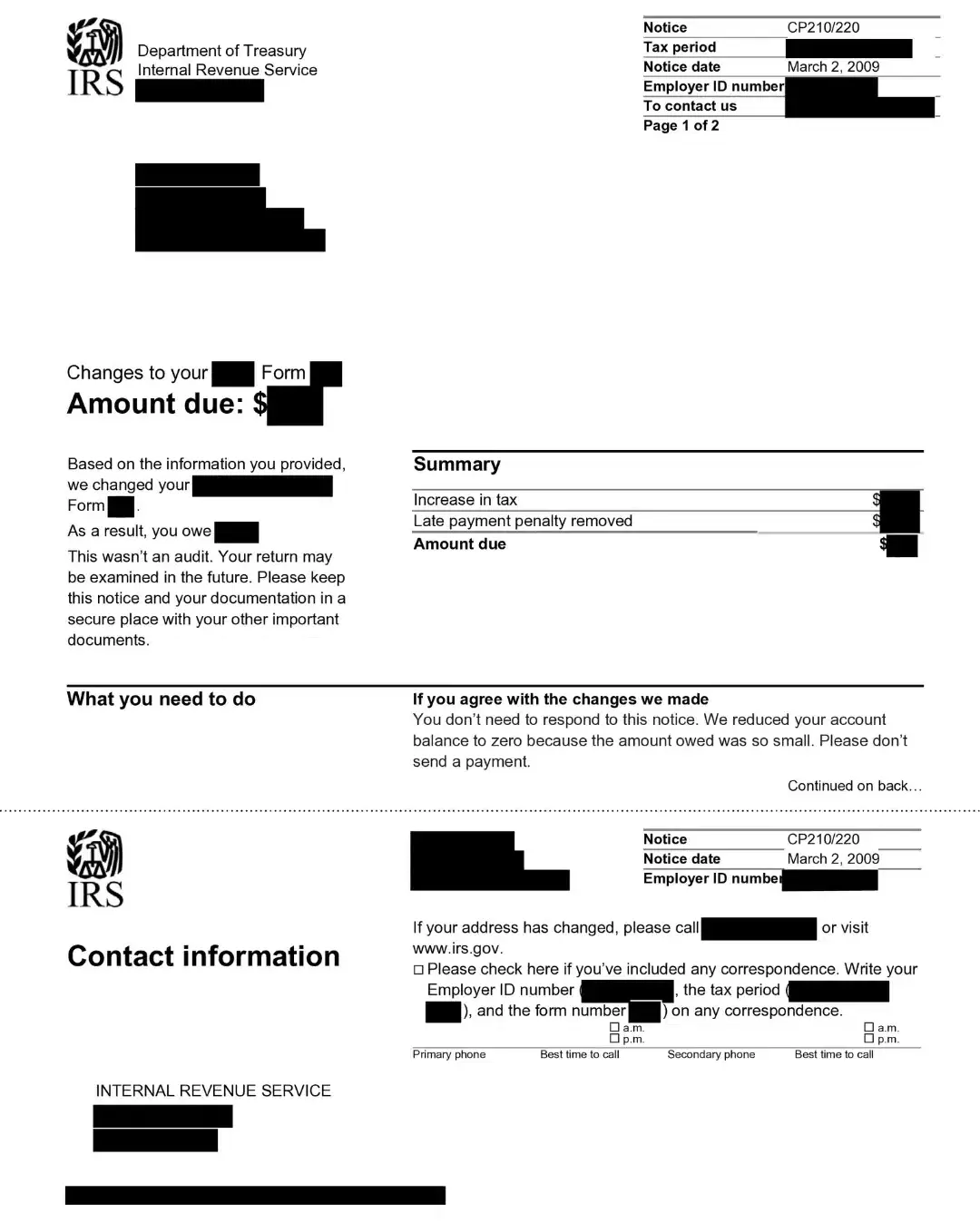
If your business recently received IRS Notice CP210 or IRS Notice CP220, the Internal Revenue Service has adjusted a previously filed business tax return.
Whether the adjustment stems from a mathematical calculation error, payroll tax deposit discrepancy, or missing tax schedule, understanding the difference between these two notices and meeting the response deadline are critical to protecting your business from interest and penalties.
At a Glance: CP210 vs. CP220
While both notices report changes to a business tax filing, the key distinction according to the Internal Revenue Manual (IRM 3.14.1) comes down to the financial result:
- IRS Notice CP210: Sent when an adjustment results in a refund, credit, or zero balance. Action is only required if you disagree with the change. The financial risk is generally low to moderate.
- IRS Notice CP220: Sent when an adjustment results in a balance due. Action is mandatory, and you must pay or formally dispute the amount within 60 days. The financial risk is high due to accruing interest and penalties.
Both notices affect the same business tax forms, including Form 940, Form 941, Form 1120, Form 1120-S, Form 1065, and Form 1041.
What Is IRS Notice CP210?
An IRS Notice CP210 informs a business entity that the IRS adjusted its tax return. This typically occurs when quarterly estimated tax payments exceed the finalized liability, payroll penalties are recalculated resulting in a credit, or employment figures on Form 941 are corrected. The outcome leaves your business with an increased refund, a reduced refund, an applied credit toward another tax period, or an adjusted tax liability with no remaining balance due.
What Is IRS Notice CP220?
An IRS Notice CP220 is a notice of tax adjustment that creates an amount owed. The IRS adjusted your business return and determined that you now owe additional taxes, penalties, or interest. Common causes include unpaid employment tax discrepancies on Form 941, disallowed business deductions on Form 1120 or 1120-S, mismatches between reported revenues and third-party 1099 filings, or late federal tax deposits via EFTPS.
Warning: Ignoring a CP220 notice can trigger collection actions, including IRS intent-to-levy notices, tax liens, and cascading failure-to-pay penalties.
What About IRS Notice CP220J?
If your notice includes a “J” suffix (CP220J), it refers specifically to an Employer Shared Responsibility Payment (ESRP) under the Affordable Care Act (ACA). The IRS issues CP220J notices to Applicable Large Employers (50+ full-time equivalent employees) that failed to offer qualifying, affordable health coverage. Unlike standard CP220 adjustments, CP220J notices involve substantial regulatory penalties and require specialized tax resolution.
Steps to Handle a CP210 or CP220 Notice
- Verify Notice Details: Check your notice for the Tax Form Number (e.g., Form 941, Form 1120), Tax Period (e.g., Q3, FY), and Employer Identification Number (EIN) or Social Security Number.
- Reconcile IRS Adjustments Against Your Records: Review the line-by-line breakdown provided in the notice against your internal accounting software, general ledgers, payroll tax reports, income documentation, and original tax returns to determine if you agree or identify discrepancies.
- Respond Before the 60-Day Deadline: If you agree, pay any balance due indicated on Notice CP220 via EFTPS (Electronic Federal Tax Payment System) or IRS Direct Pay, and keep a copy with your permanent tax records. If you disagree, you have 60 days from the notice date to contact the IRS by phone or send a written response to the listed address with supporting documentation (payroll logs, canceled checks, bank statements, 1099 forms) or an amended return.
Can You Reduce or Remove CP220 Penalties?
Yes. If your CP220 notice includes Failure to Deposit (FTD) or Failure to Pay penalties, you may qualify for penalty abatement under two main programs:
- First-Time Penalty Abatement (FTA): Available if your business has maintained a clean compliance record for the preceding three tax years.
- Reasonable Cause Relief: Applicable if filing or payment errors occurred due to natural disasters, serious illness, or reliance on erroneous written advice from the IRS.
Need Help Eliminating IRS Penalties?
Submitting a penalty abatement request requires formal administrative petitions, detailed documentation, and an in-depth understanding of IRS regulations. If your business owes penalties on a Notice CP220, working with Community Tax’s Preparation Service can help you prove reasonable cause or leverage First-Time Abatement to eliminate unnecessary fees and protect your cash flow.